
Responsible Automation and Applied Informatics
Summer School: 22.06.2026 – 3.09.2026
Organized by Systems for Intelligent Management of information (SIMfo) Laboratory, PRECIS Centre, Faculty of Automation and Computer Science, POLITEHNICA Bucharest
The period of applications has ended. More details will be available on Moodle and MS Teams for the enrolled students.
Previous edition: RAAI 2025
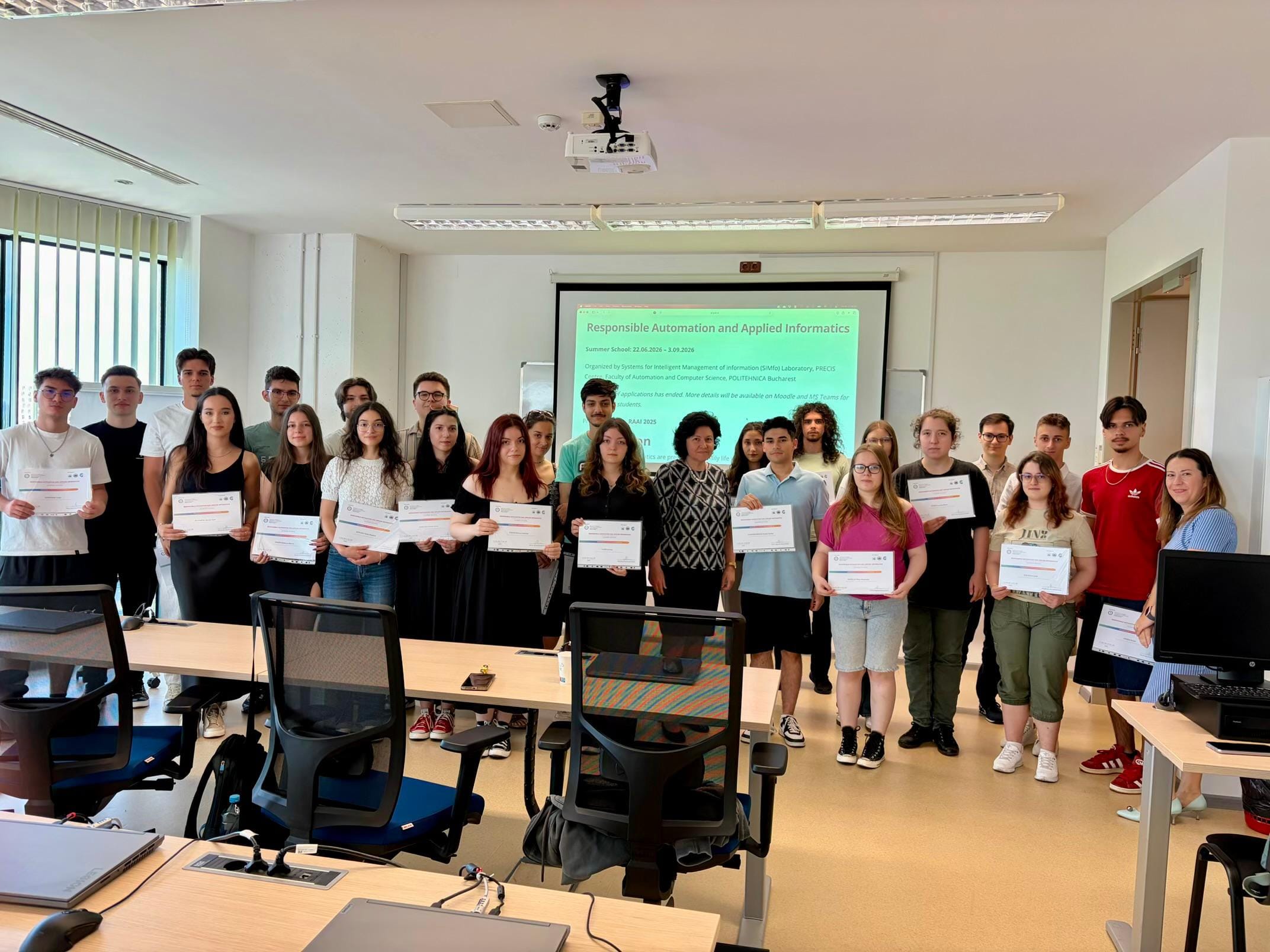
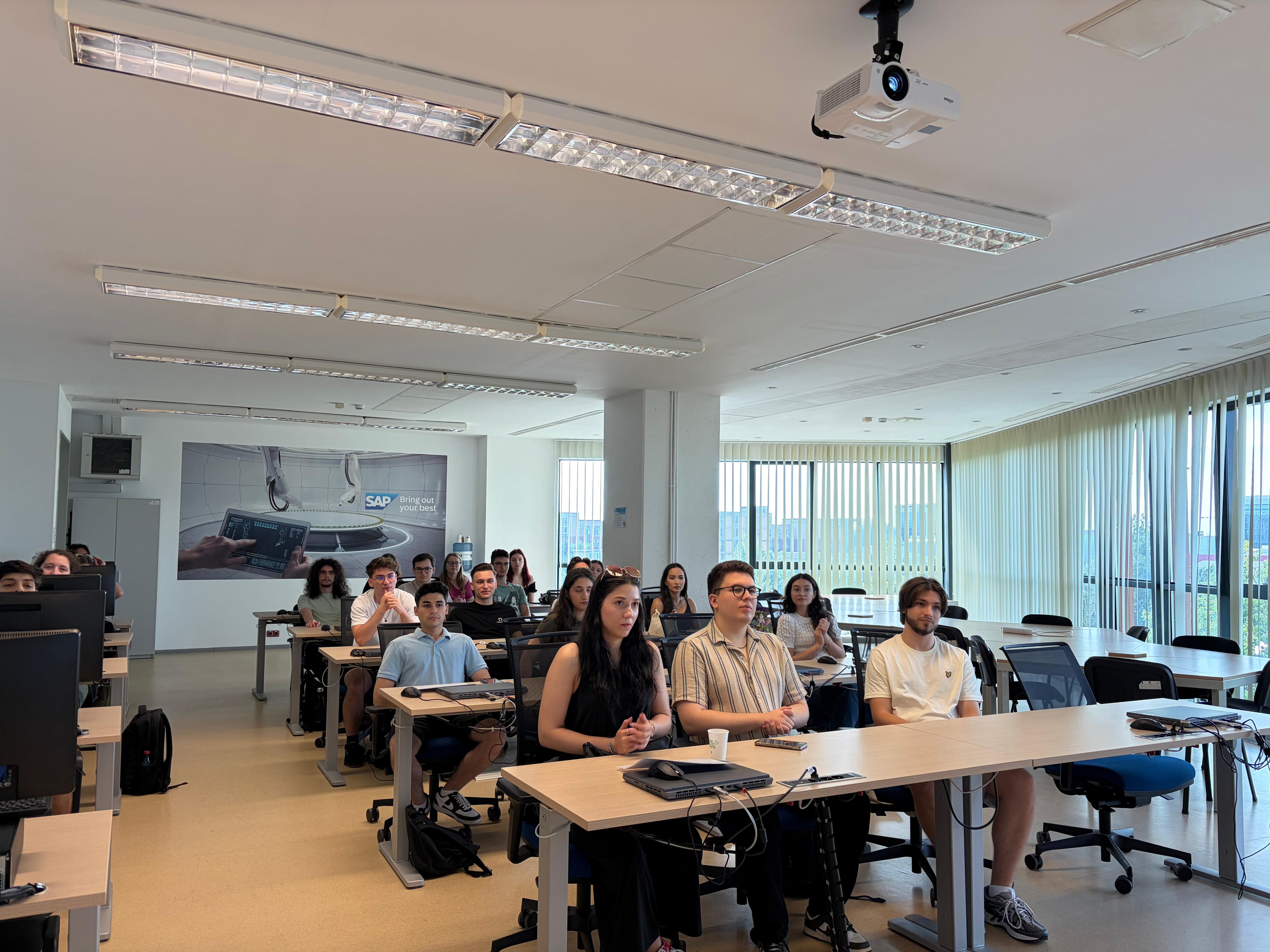
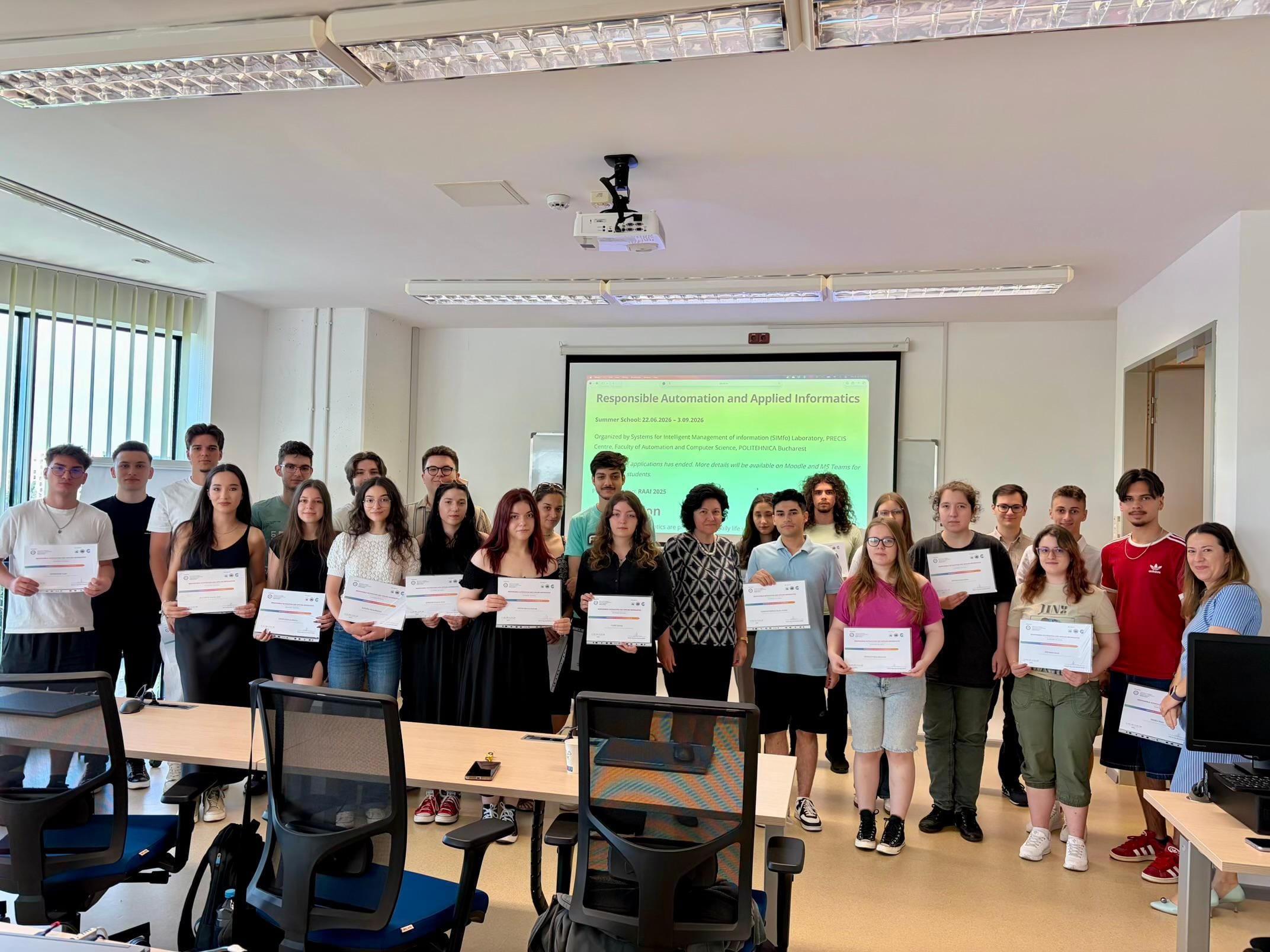
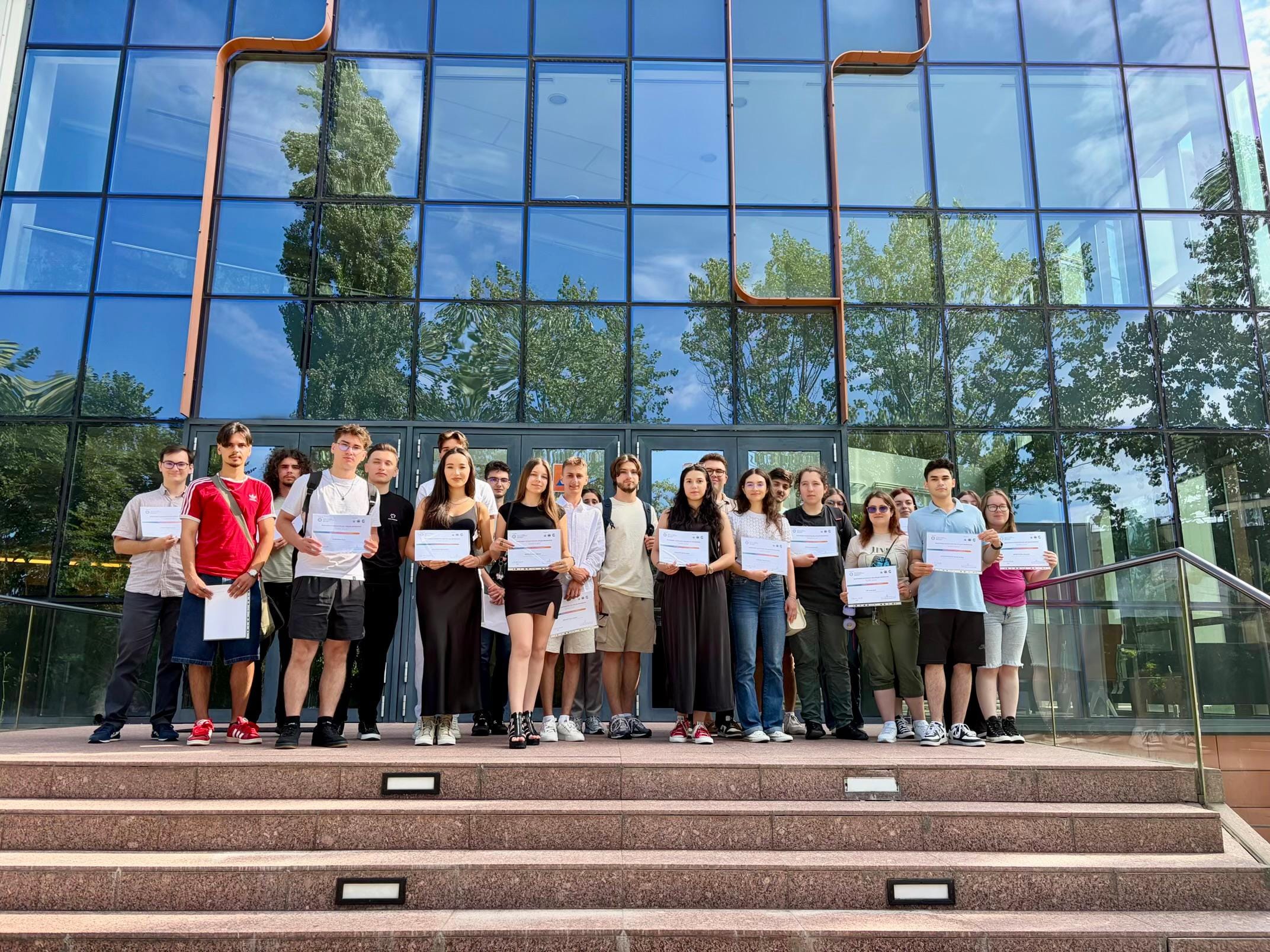
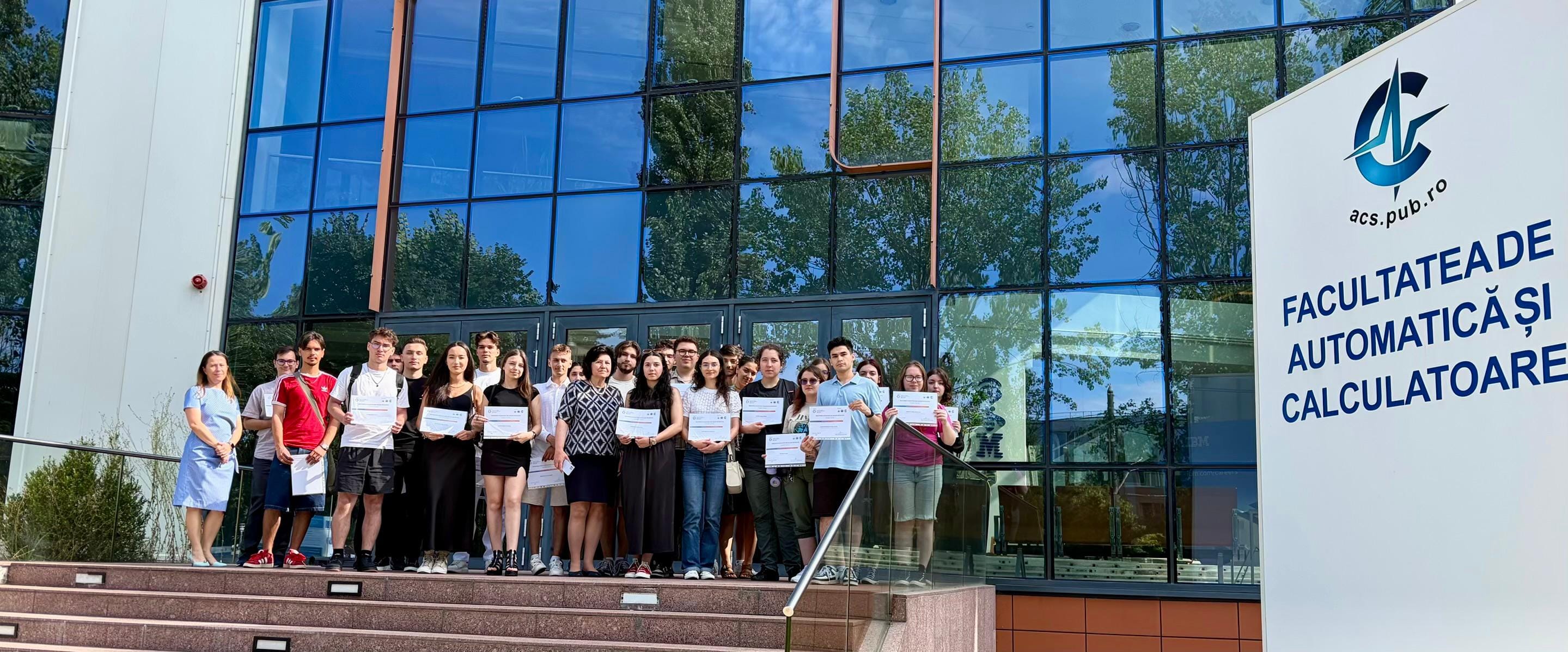
Description
Automation and informatics are present in our daily life without even realizing it most of the time; they change our lives for better or for worse. Our students aim at becoming excellent programmers, professionals able to integrate software, hardware, and control aspects in reliable applications and systems. However, is it enough in today’s world? Our concern is that they also become responsible and aware of the impact produced on end users, society, climate, and available resources. The topics to be discussed include but are not limited to:
- Generative AI and Software Development
- Artificial Intelligence and System Self-adaptation
- Cloud Computing and Shared Responsibility
- Research Ethics and Regulatory Frameworks
- Cybersecurity and Socio-Technical Systems
This summer school brings together students interested in automation, applied informatics, and intelligent systems, with specialists from academia, research and industry, within a series of hybrid lectures and workshops, optionally followed by individual projects. We wish to tackle the problems and the technical solutions that are also responsible from multiple points of view.
General Program
22.06 – 10.07 – Workshops and lectures
Invited Speakers
Prof. Joe Francom, Utah Tech University
A primer on containers and Kubernetes
This hands-on workshop introduces participants to the core concepts of containerization and orchestration using Docker and Kubernetes. Over the course of three hours, attendees will learn how to package applications into portable containers, manage dependencies efficiently, and deploy those containers in a scalable, production-like environment. The session is designed to be practical and accessible, with guided exercises that walk through building, running, and troubleshooting containerized applications.
By the end of the workshop, participants will understand how Docker simplifies development workflows and how Kubernetes enables reliable deployment, scaling, and management of containerized systems. Whether you’re new to containers or looking to connect the dots between development and operations, this workshop provides a concise, hands-on foundation you can immediately apply to real-world projects.
Dr. Francom specializes in DevOps, cloud computing, and software development. He is passionate about finding creative ways to bring cutting-edge technology into the classroom. He has 25+ years in higher education. When he’s not teaching, he enjoys hiking, mountain biking, and exploring Utah with his wife and four children.
Prof. Marin Litoiu, York University, Toronto, Canada
Self Adaptive Agentic AI Systems
Marin Litoiu is a Professor of Software Engineering in the Department of Electrical Engineering and Computer Science and in the School of Information Technology, York University. He is also a Fellow of the Canadian Academy of Engineering. Dr. Litoiu leads the Adaptive Software Research Lab and focuses on making large software systems more versatile, resilient, energy-efficient, self-healing, and self-optimizing. His research won many awards, including the IBM Canada CAS Research Project of the Year Award, the IBM CAS Faculty Fellow of the Year Award for his “impact on IBM people, processes and technology,” three Best Paper Awards, and two Most Influential Paper Awards. Prior to joining York University, Dr. Litoiu was a Research Staff member with the Centre for Advanced Studies in the IBM Toronto Lab, where he led the research programs in software engineering and autonomic computing. He received the Canada NSERC Synergy Award for Innovation in recognition for these collaborative university/industry activities. He was also the recipient of the IBM Outstanding Technical Contribution Award for his research vision on Cloud Computing. Dr. Litoiu is one of the founders of the SEAMS Symposium series—ACM/IEEE Software Engineering for Adaptive and Self-Managing Systems. He has been the General Chair of SEAMS in 2013 and 2019, ACSOS 2023, ICPE 2025, Program Chair of SEAMS, ICPE, and CASCON, and serves on the steering committees of SEAMS and CASCON. Dr. Litoiu is also the Scientific Director of „Dependable Internet of Things Applications (DITA),” an NSERC CREATE program.
Dr. Iosif Viorel (Vio) Onut, IBM Canada, University of Ottawa
A Journey Through Responsible GenAI Use
As Generative Artificial Intelligence (GenAI) continues to evolve, its influence reaches far beyond the enterprise, reshaping how society creates, consumes, and trusts information. While GenAI holds immense promise for innovation and societal advancement, it simultaneously introduces a profound new class of risk: the ability to manufacture convincing falsehoods at scale. From mass misinformation campaigns and synthetic media that blur the line between real and fabricated, to the distortion of shared reality itself, GenAI is reshaping the threat landscape in ways traditional defenses were never designed to address. These same capabilities supercharge cyber threats, enabling advanced social engineering attacks that impersonate individuals more convincingly than ever before and circumvent conventional security measures.
This presentation explores the double-edged nature of GenAI through the lens of its societal impact, examining how mass misinformation, reality distortion, and AI-enabled cyber-attacks intersect to challenge institutions, erode public trust, and endanger individuals. By contrasting responsible and irresponsible uses of the technology, it aims to raise awareness and equip the audience with the foundational knowledge needed to recognize, resist, and safeguard against this emerging generation of threats.
Iosif Viorel (Vio) Onut is Associate Partner – Cyber Strategy and Risk & Master Inventor at IBM Security. He is an Adjunct Professor at the University of Ottawa and co-director of the University of Ottawa and IBM Cyber Range. He specializes in cybersecurity and cybercrime research and development. He is also passionate about curriculum and product innovation acceleration through R&D. Over the past decade, he has managed over 150 research projects involving 35 universities, led by over 90 professors, over 360 students, and over 330 IBM staff.
Prof. Grigore Stamatescu, POLITEHNICA University, Bucharest, Romania
Cybersecurity of Industrial Control Systems
The lecture will present general concepts for assuring the cybersecurity of industrial control systems (ICS). The Purdue model for ICS cybersecurity will be discussed, alongside the NIST SP800-82r3 guide for operational technology (OT) security. Critical standardization aspects will be covered in the form of the ISO27001 – Management System for Information Security and ISA/IEC 62443 – Industrial cybersecurity families of standards. The current European regulation and certification landscape for essential operators of critical infrastructures (e.g., NIS2 directive) represents a key driver for compliance through technological advances and organizational measures in this area. Case studies are demonstrated in the analysis of industrial communication network logs for attack patterns using dedicated software tools, together with the configuration and testing of specialized hardware systems for ICS protection e.g,. Siemens Scalance S615 with SINEMA VPN and S7-1200/-1500 series PLCs.
Grigore Stamatescu holds the Ph.D. degree (2012) from the University Politehnica of Bucharest, where he is currently a Professor (Habil. 2019) with the Department of Automation and Industrial Informatics, leading the Artificial Intelligence for SEnsing, Low-Power Networking and ICS SEcurity (AISENSE) laboratory. His main research interests currently include the Internet of Things and artificial intelligence for industry and energy applications, and his research results have been published in over 150 articles. Dr. Stamatescu was a Fulbright Visiting Scholar 2015-2016 at the University California, Merced, on distributed sensing and advanced control in smart buildings, and a 2019 JESH Scholar of the Austrian Academy of Sciences at the Graz University of Technology on data-driven modelling of manufacturing systems. He is a Senior Member of IEEE and a 2025-2027 Distinguished Lecturer of the IEEE Instrumentation and Measurement Society in the field of “Big Measurement Data”.
Dr. Roxana Radu – National Institute of Materials Physics (NIMP), Romania, Marie Curie Alumni Association
Architecting Trust: Research Ethics and Regulatory Frameworks in Romania and the EU
Dr. Andrada Lazea-Stoyanova – National Institute for Laser, Plasma & Radiation Physics (INFLPR), Romania, Marie Curie Alumni Association
How a Marie Sklodowska-Curie Fellowship can accelerate your research career
Industry Workshops
SAP – Building Data Driven Software in the Era of Generative AI
In enterprise software, data driven decision making and extracting insights from large amounts of information are essential. With this workshop we’re touching the intersection of Data Science methods and the new Generative AI technology.
Speaker: Radu Purdel, Principal Development Architect @ SAP, with more than 20 years of software engineering experience
Microsoft – Azure Subscription and Copilot
Microsoft Storage – Speaker: Andi-Bogdan Postelnicu, Microsoft Romania
Azure Subscription – Speaker: Dr. Dorin Ungureanu, Microsoft Romania
Copilot in Visual Studio Code – Speaker: Dr. Dorin Ungureanu, Microsoft Romania
IBM – Generative AI and Quantum Computing
Leveraging Capabilities of GenAI with IBM watsonx
This workshop introduces students to Generative AI and IBM’s watsonx platform. Participants explore foundation models, LLMs, and common GenAI tasks like summarization, content creation, RAG and Agentic AI. The session covers prompt engineering tips, hands-on experimentation in the watsonx, and real-world IBM case studies showcasing productivity gains of up to 70%.
Speakers: Andra Bichea, Mihai Neagu, IBM Romania
Build with Local LLMs: Ollama + Cline Workshop
This workshop introduces students to local large language models as a practical development tool. Participants will install and configure Ollama, select and run an open-source coding model, and integrate it with VS Code using the Cline extension. The session culminates in a guided build where students use AI assistance to develop a functional web application. No prior experience with LLMs is required.
Speaker: Sorina Radulescu, IBM Romania
Introduction to Quantum Artificial Neural Networks
This workshop focuses on providing intuitive representations and analogies to facilitate the assimilation of specific Quantum Computing and Artificial Neural Networks (ANN) concepts by students and other interested individuals. First, the classical artificial neuron is discussed along with its limitations to linearly separable problems. Various multi-dimensional representations are considered for a better understanding of the Multi-Layer Perceptron (MLP) and the corresponding Backpropagation training algorithm. The main Quantum Computing concepts are discussed in relation to the “Semaphores Analogy” and the Bloch Sphere.
Speaker: Dr. Valeriu Grossu, IBM Romania
Asti Automation – Development of modern PLC Applications using Siemens TIA Portal
The workshop will present modern programmable logic controller applications in a comparative approach based on technologies from reputable manufacturers (Siemens, Allen Bradley, Beckhoff, Phoenix Contact, Bosch Rexroth). The IEC 61131-3 standard for PLC software development will be discussed together with key principles in building Human Machine Interfaces (HMI) for industrial process monitoring and control. Integration and interoperability aspects for industrial communication using open-source tools will be investigated. Case studies include modelling of a typical industry application using state diagrams and the development of an end-to-end automation project using Siemens TIA Portal technologies.
Speaker: Mihai-Daniel Pavel, ASTI Automation
Mihai-Daniel Pavel is an Automation R&D Engineer in Asti Automation where he designs and develops new technical training systems for industry digitalization in automation, mechatronics and robotics.
eSolutions – Build Your Own AI Squad
Build Your Own AI Squad: a workshop where students learn how to design and connect multiple AI agents that collaborate on real tasks.
Speaker: Emil Calofir, eSolutions
11.07 – 4.09 – Individual projects
Individual projects as a continuation of the workshop and lectures period (Optional)
Organizers
SIMfo Laboratory
Contact
Anca Daniela IONIŢĂ, POLITEHNICA Bucharest
Iulia STAMATESCU, POLITEHNICA Bucharest
Web Chair
Iulia IACOB, POLITEHNICA Bucharest
Location
National University of Science and Technology POLITEHNICA Bucharest
Automation and Computer Science Faculty / PRECIS Research Centre